

Wisdom teeth are the last adult teeth to come through, usually appearing in the late teens or early twenties. For many people, they cause little trouble. For others, a wisdom tooth that only partially breaks through the gum can lead to pain, infection, and other dental problems that are worth understanding early.
A partially erupted wisdom tooth leaves a gap between the gum and the tooth surface where bacteria and food debris can settle. That gap is difficult to clean and can become a persistent source of irritation. If you are noticing discomfort at the back of your jaw, understanding more about wisdom tooth removal can help you decide when to seek care.
Quick Overview
- A partially erupted wisdom tooth has broken through the gum only partway, leaving part of the tooth covered by gum tissue
- It may affect people in their late teens to mid-twenties, though symptoms can appear later in some cases
- Depending on the position of the tooth and any symptoms present, a dentist may recommend monitoring, managing symptoms, or removal
- Whether treatment is needed depends on the tooth’s angle, available space in the jaw, and whether problems like infection or decay have developed
- A dental examination with X-rays helps determine what, if anything, needs to be done
Keep reading to understand why partial eruption happens, what symptoms to watch for, and what your options may be.
What Is a Partially Erupted Wisdom Tooth?
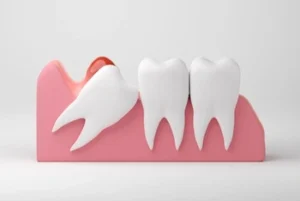 A wisdom tooth is partially erupted when it has broken through the gum line but has not fully come through into its correct position. Part of the tooth remains covered by a flap of gum tissue, known as an operculum.
Most people have four wisdom teeth, one in each corner of the mouth. Wisdom teeth are the last molars to come through, usually in the late teens or early twenties, and sometimes they push through at an angle or become stuck against the tooth in front.
When a wisdom tooth cannot fully emerge, it is described as impacted. Partial eruption is a form of impaction where the tooth has made some progress through the gum but lacks the space or correct angle to come through completely.
Why Does Partial Eruption Happen?
The most common reason is a lack of space in the jaw. Over time, human jaws have become smaller, and many people simply do not have enough room for a full set of 32 teeth. When the wisdom tooth tries to erupt, it may press against the second molar in front of it or angle in a direction that prevents full eruption.
Other contributing factors include:
- The angle of the tooth in the jawbone, which may be tilted forward, backward, or sideways
- The density of the surrounding bone, which affects how easily the tooth can move
- The size of the tooth itself relative to the available space
- Gum tissue that does not recede as the tooth pushes through
Not everyone with a partially erupted wisdom tooth will experience problems. Some people are monitored over time without needing any treatment.
What Are the Symptoms to Watch For?
Symptoms vary depending on the person and how the tooth is positioned. Some partially erupted wisdom teeth cause no discomfort at all and are only discovered on X-ray during a routine check-up.
Common symptoms include:
- Pain or aching at the back of the jaw, which may come and go or worsen when biting down
- Swollen or tender gum tissue around the back of the mouth
- Bad breath or an unpleasant taste, caused by bacteria building up under the gum flap
- Jaw stiffness, making it difficult to open the mouth fully
- Mild pain that spreads to the ear, temple, or nearby teeth
When bacteria become trapped under the gum flap, the surrounding tissue can become inflamed and infected. This condition is called pericoronitis, and it is one of the more common problems associated with partially erupted wisdom teeth. In some cases, pericoronitis can recur repeatedly if the underlying cause is not addressed.
What Problems Can a Partially Erupted Wisdom Tooth Cause?
Left unmanaged, a partially erupted wisdom tooth may lead to several dental complications over time.
Infection and pericoronitis. The gum flap over a partially erupted tooth traps food and bacteria. This can lead to swelling, pain, and repeated bouts of infection. In some cases, the infection may spread to the surrounding jaw or throat tissues, which requires prompt attention.
Tooth decay. The area around a partially erupted tooth is hard to clean properly. Plaque builds up between the gum and tooth, increasing the risk of decay in the wisdom tooth itself and in the second molar in front of it. Lower wisdom teeth take longer to come through and are more likely to become impacted, making repeated infections more likely.
Gum disease. Poor access for cleaning around partially erupted teeth increases the risk of gum disease developing in the area.
Pressure on nearby teeth. A wisdom tooth angled toward the second molar may push against it over time, causing discomfort or contributing to crowding.
What Are the Treatment Options?
Not every partially erupted wisdom tooth needs to be removed. The right approach depends on the symptoms, the tooth’s position, and your overall dental health.
Monitoring. If the tooth is not causing problems and X-rays show it is stable, a dentist may recommend watching it over time with regular check-ups and imaging. This is appropriate when there are no signs of infection, decay, or pressure on nearby teeth.
Symptom management. For mild discomfort or early-stage infection, rinsing with warm salt water can help reduce inflammation. Over-the-counter pain relief may also be appropriate in the short term. A dentist may prescribe antibiotics if infection is present.
Removal. If the tooth is causing repeated infections, decay, gum disease, or damage to the tooth beside it, removal is often recommended. If removal is recommended, your dentist can explain what the procedure involves and what to expect.
Removal is generally simpler when undertaken before the roots are fully formed, which is why earlier assessment tends to be beneficial for those with ongoing symptoms.
What Happens During and After Removal?
For most partially erupted wisdom teeth, removal is carried out under local anaesthetic in the dental chair. If the tooth is more deeply positioned or the procedure is expected to be more complex, sedation options may be discussed with your dentist.
After removal, some swelling, soreness, and minor bleeding in the first few days is normal. Recovery is typically straightforward. One potential complication to be aware of is dry socket, which occurs when the blood clot in the tooth socket is dislodged or does not form properly, exposing the underlying bone and nerves. Dry socket is more common in lower wisdom tooth extractions and in people who smoke. It occurs in approximately 1 in 20 tooth extractions and can be treated by a dentist once identified.
General post-removal care suggestions include:
- Avoiding sucking through a straw or excessive rinsing in the first 24 hours
- Eating soft foods while the area heals
- Rinsing gently with warm salt water after meals once 24 hours have passed
- Avoiding smoking, which increases the risk of dry socket and slows healing
Individual recovery time varies depending on the complexity of the removal and each person’s healing response.
A Considered Approach to Wisdom Teeth at Clarinda Clinic
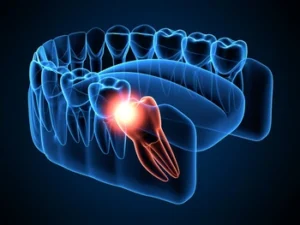 A partially erupted wisdom tooth does not always require immediate action, but it does benefit from proper assessment. Understanding the position of the tooth, the condition of the surrounding gum and bone, and whether any complications are developing allows for a more informed conversation about what to do next.
At Clarinda Clinic, Dr Andrew Hong and Dr Jane Snell take time to examine each patient carefully, explain what the X-rays and examination show, and discuss care options that suit each individual situation.
To arrange an assessment, call us on (03) 6160 1078 or contact our dental team online.
Note: Any surgical or invasive procedure carries risks. Before proceeding, you should seek a second opinion from an appropriately qualified health practitioner.
Frequently Asked Questions
Can a partially erupted wisdom tooth fix itself?
In some cases, a wisdom tooth that is partially through the gum may continue to erupt slowly without causing ongoing problems. However, if there is not enough space in the jaw or the tooth is angled incorrectly, full eruption is unlikely. A dentist can assess the position of the tooth using X-rays to determine whether it is likely to continue moving or has become stuck in its current position.
How do I keep the area clean while waiting for treatment?
Keeping the area around a partially erupted wisdom tooth as clean as possible can help reduce the build-up of bacteria under the gum flap. Using a soft-bristled toothbrush to gently clean as far back as you can reach, rinsing with warm salt water after meals, and using an antibacterial mouthwash if recommended can all help. Avoid poking at the gum flap or using sharp objects to remove food. A dentist can show you cleaning techniques that are appropriate for the position of your tooth.
References
Better Health Channel. (n.d.). ‘Wisdom teeth’. Better Health Channel. Melbourne, VIC: Victorian Department of Health. https://www.betterhealth.vic.gov.au/health/conditionsandtreatments/wisdom-teeth
Healthdirect Australia. (n.d.). ‘Removing wisdom teeth’. Healthdirect Australia. Sydney, NSW: Healthdirect Australia. https://www.healthdirect.gov.au/surgery/removing-wisdom-teeth
Australian Dental Association. (n.d.). ‘Wisdom Teeth’. Teeth.org.au. Sydney, NSW: Australian Dental Association. https://www.teeth.org.au/wisdom-teeth
Healthdirect Australia. (n.d.). ‘Dry socket’. Healthdirect Australia. Sydney, NSW: Healthdirect Australia. https://www.healthdirect.gov.au/dry-socket